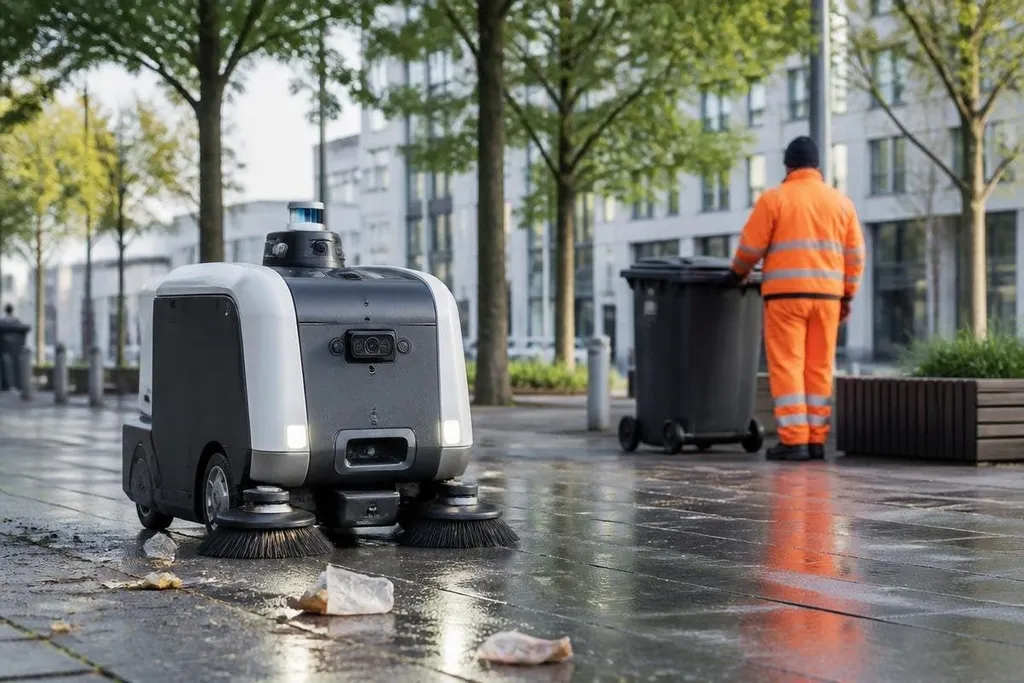
Waste management robots are being built for work that is repetitive, dirty, or unsafe for people to do all day.
Their jobs include spotting litter, emptying bins, and moving waste through sorting lines, but each task depends on the same basics: sensors, a moving base, and software that reacts to the site.
This overview stays at the mechanism level because no deployment data was supplied. The useful question is where a robot can work without adding more supervision than the job already needs.
- Street cleaning: Cameras and other sensors help a robot find waste on paths, roads, and public areas.
- Bin service: A robot can locate, approach, lift, or empty containers when its design supports those tasks.
- Sorting support: Robotic arms and vision systems can identify items and move them between waste streams.
Where the robots work
Street-cleaning robots need a clear route, a way to detect people and objects, and enough battery power for the planned shift. A camera can spot visible litter, while LiDAR measures distance by sending out laser pulses and reading their return.
The robot turns those readings into a map of nearby objects. Its control software then chooses a safe path around curbs, benches, parked vehicles, and people. That makes the work different from a fixed factory robot, which can repeat the same motion inside a guarded area.
Public spaces add another problem: the ground changes. Leaves, loose packaging, wet waste, and broken glass can all affect the robot's wheels, brushes, suction system, or gripper. A city needs a plan for clearing blockages and checking the machine after contact with sharp objects.
What the robot actually changes
The main gain comes from keeping a task running for longer without asking a person to repeat the same search by hand. A robot can scan a defined area, collect the items it can identify, and send a record of blocked routes or full bins to a supervisor.
That record matters because waste work has a physical route and a service schedule. If a robot marks a bin as full, staff can plan the next collection around that information instead of checking every container at random. The system still needs a person to decide what happens when the sensor reading is wrong.
Sorting robots work in a different setting. A vision system studies an item on a conveyor, then an arm moves it toward a chosen bin. The arm needs the right end effector, which is the tool at its tip, for the material it must pick up. A suction cup may handle a flat item; a mechanical gripper may work better on a rigid object.
Sorting speed means little if a report leaves out the waste type, conveyor speed, and error rate. For a buyer, a report from Robot 24 can place those figures beside the machine, test site, and date before the next section looks at where sorting systems fail.
Where the limits show up
Waste is hard to classify. A dirty container can differ from the item used to train the vision system, while soft packaging can fold, stick, or move when the arm touches it.
A robot that works on clean test samples may need more supervision on a mixed waste line.
Weather adds another source of failure. Rain can change camera images and floor grip. Heat affects batteries and electronics. Dust can cover lenses and moving parts. The maker must state the conditions the robot can handle, then show how often staff need to clean, charge, repair, or reset it.
Safety also sets the working area. A street robot needs brakes, obstacle detection, and a clear response when someone steps into its path. A sorting arm needs guards, stops, and a way for staff to reach the work area safely during service.
I’d choose a waste robot for a narrow route with repeatable conditions before using one across a whole city.
A practical buying checklist
Use these questions before a city, contractor, or recycling plant starts a pilot:
- Name the task: Is the robot collecting litter, servicing bins, moving material, or sorting it?
- Map the site: List slopes, curbs, doors, traffic, weather exposure, and places where people cross the route.
- Check the handoff: Decide who removes jams, empties the robot, charges it, and responds to alerts.
- Measure the result: Record collection rate, missed items, stopped hours, staff time, and repair work.
- Set a failure rule: State when a person takes over and how the robot returns to service.
A pilot earns its place when the robot handles a defined job with less supervision than the old method. The next proof cities need is not a staged pickup; it is a full work record showing what the robot collected, where it stopped, and how much human time remained.